Cancellations Pile Up After FAA Ground Stop; Duffy Blames Overloaded Old Equipment
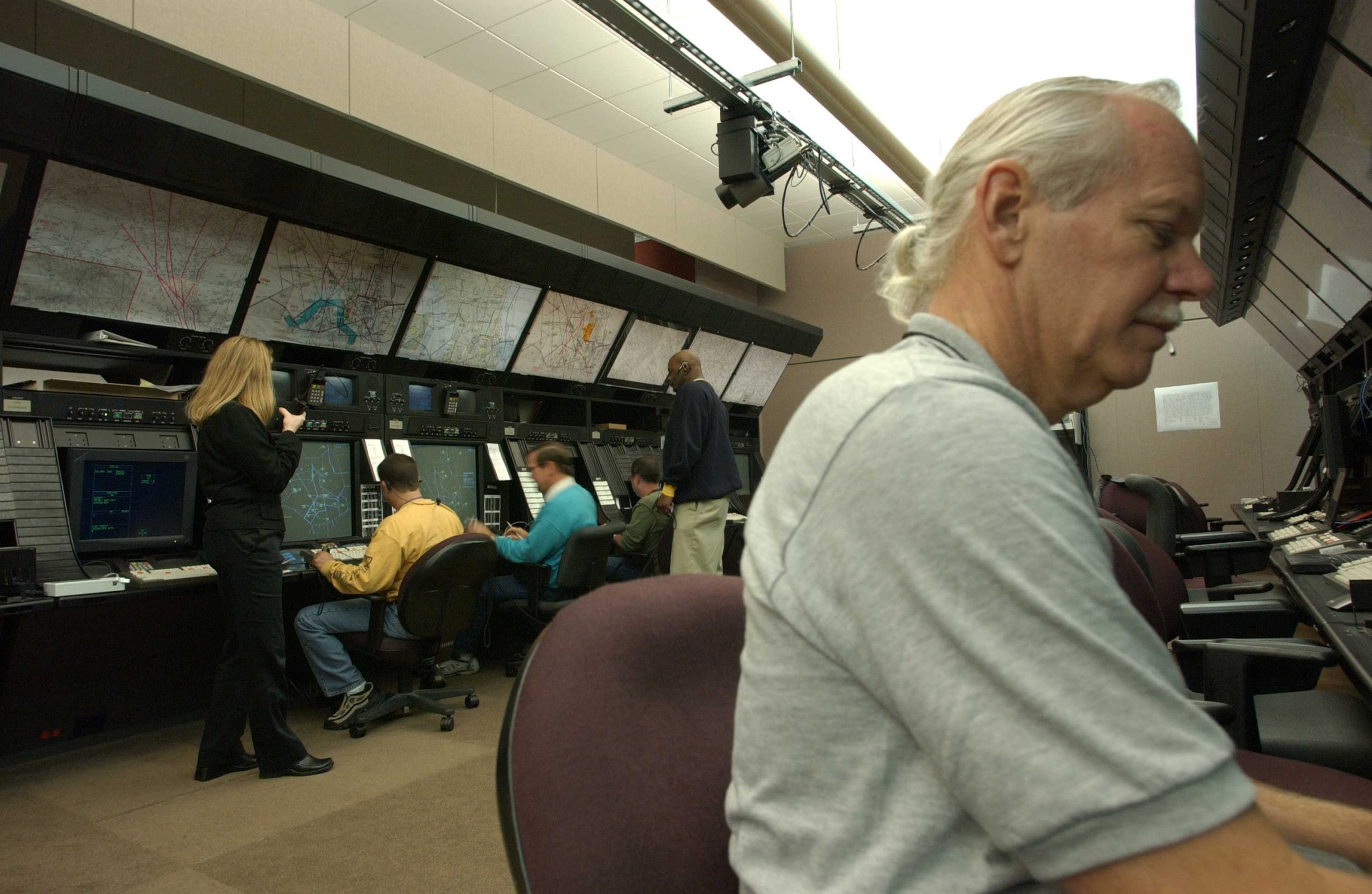
Photo: Federal Aviation Administration, Public domain, via Wikimedia Commons
The FAA lifted its nationwide ground stop at 8:15 p.m. ET Friday, more than four hours after it halted departures from U.S. airports at 3:54 p.m. ET. Airlines were still digging out on Saturday.
More than 3,000 U.S. flights were canceled Saturday and close to 1,000 were delayed as of 5:45 a.m. ET, according to FlightAware data reported by CNBC. That came on top of about 9,000 U.S. cancellations on Friday, though bad weather caused some of those. Pro and college sports teams scrambled to reach weekend games, and some college football games were postponed.
Duffy said the trouble began at 3:36 p.m. ET, when radar data and communications with airplanes became unstable at TRACONs, the approach-control facilities around airports, and at the en route centers that handle high-altitude traffic across the country. More than 3,500 airplanes were in the air when the FAA stopped departures, and controllers brought them down safely, he said.
Duffy blamed aging equipment. He said switches and routers in the FAA’s legacy network were overloaded, a problem with TDM, or time-division multiplexing, an old technology that still runs mostly over copper wire and carries controllers’ voice and radar data. “We have old, old switches, old routers, we use 1980s little copper lines,” he said. Communications and radar became intermittent but never went completely dark, according to Duffy.
The FAA deployed fixes to reduce the overloading on its switches and bring its centers and TRACONs back online, Duffy said. The agency said it tested its systems to confirm they were stable before clearing flights to resume.
Officials gave differing accounts of what role new equipment played. Homeland Security Secretary Markwayne Mullin said it appeared that new equipment and technology being added to the system as patches had overwhelmed the older system. Duffy said none of the new equipment the FAA has installed went down and that the failure was in legacy equipment.
Mullin said there was no sign so far of a cyberattack. "It appears that this was mechanically driven," he said at the briefing, adding that investigators were still looking and would not rule anything out. He also said the public was never in danger.
Duffy had warned that flights would restart slowly, depending on whether crews are available, and that it will take some time for travel to return to normal. He said he expects operations to be back up by the Thanksgiving travel rush.
Duffy also called on Congress to provide $50 billion to finish modernizing the air traffic control system, on top of the $12.5 billion already approved.
Reuters reported it was the longest nationwide shutdown since the Sept. 11, 2001, attacks. The only other nationwide ground stop since then, in January 2023, halted domestic departures for about 90 minutes.
Verified Facts
- The nationwide ground stop lifted at 8:15 p.m. ET on Friday, Transportation Secretary Sean Duffy said. (New York Post, Al Jazeera)
- The FAA issued the nationwide ground stop at 3:54 p.m. ET on Friday. (Al Jazeera, BBC News)
- More than 3,000 U.S. flights were canceled Saturday and close to 1,000 delayed as of 5:45 a.m. ET, per FlightAware, on top of about 9,000 U.S. cancellations Friday, some due to bad weather. (CNBC, Axios)
- Sports teams struggled to reach weekend games, and some college football games were postponed. (CNBC, Axios)
- The problem was with the TDM — time-division multiplexing — a dated, still mostly copper-wire technology used to transmit air traffic control voice and radar data, Secretary of Transportation Sean Duffy said. (Los Angeles Times)
- There was no evidence to suggest a cyberattack or the involvement of foreign adversaries, Secretary of Transportation Sean Duffy said. (Los Angeles Times)
- The technological breakdown led to intermittent communication and radar, but not a complete blackout, Secretary of Transportation Sean Duffy said. (Los Angeles Times)
- Duffy lambasted the aging infrastructure that the FAA relies on. (Los Angeles Times)
- Duffy said air traffic control would try to move as many planes as possible Friday night but that this will depend on the availability of flight crews and pilots. (Los Angeles Times)
- Duffy cautioned that it will take "some time" for travel to get fully back to normal. (New York Post)
- Duffy said flights would resume depending on the availability of pilots and flight attendants, with authorities trying to get as many flights moving as possible on Friday night. (Al Jazeera)
- Duffy said it will take some time to get back to capacity but expected operations to be back up and operational as we come into the heat of travel during Thanksgiving. (Al Jazeera)
- US Homeland Security Secretary Markwayne Mullin said there was no indication the communications breakdown resulted from a cyberattack or artificial intelligence and that the public was never in danger. (DW News)
- The FAA lifted the ground stop and some flight departures are resuming. (x.com)
- Before clearing flights to resume, the FAA thoroughly tested its systems to confirm they were stable and that operations remain reliable. (x.com)
- Tens of thousands of travelers were left stranded, Homeland Security Secretary Markwayne Mullin said. (Los Angeles Times)
- At 3:36 p.m., the FAA experienced instability in radar and communications at its centers and TRACONs across the country, Duffy said. (Roll Call Factbase transcript, x.com)
- The FAA deployed fixes to reduce the overloading on its switches and bring its centers and TRACONs back online, Duffy said. (Roll Call Factbase transcript)
- Mullin said it appeared new equipment and technology being added as patches was overwhelming the older system. (Roll Call Factbase transcript)
- Duffy said none of the new equipment the FAA put in went down; the failure was in old legacy equipment. (Roll Call Factbase transcript)
- Duffy said he wants $50 billion from Congress to finish the system, beyond a $12.5 billion down payment. (Roll Call Factbase transcript)
- It was the longest nationwide shutdown since the September 11, 2001, attacks; the only other nationwide ground stop since then came in January 2023 and lasted about 90 minutes. (Reuters)
- "It appears that this was mechanically driven," Mullin said, adding that investigators were not ruling anything out. (Roll Call Factbase transcript, Reuters)
Sources
- Los Angeles Times: What caused the national ground stop? Here is what we know
- New York Post: FAA lifts nationwide ground stop, 4 hours after air traffic chaos began — but thousands of NYC travelers left stranded
- Al Jazeera: FAA ground stop lifted: Why were US flights grounded, and what’s next?
- DW News: US lifts nationwide ground stop for airports hours after halting all departures
- x.com: @FAANews on X
- Reuters: US to resume flights after air traffic network failure sparks chaos
- Roll Call Factbase transcript: Press briefing transcript, Mullin and Duffy on FAA ground stop
- x.com: @SecDuffy on X
- CNBC: FAA ground stop lifted but U.S. flight disruptions continue
- Axios: 3,000 flights cancelled as FAA ground stop chaos stretches into 2nd day
- BBC News: US grounds all flights for hours over tech issues, prompting travel chaos