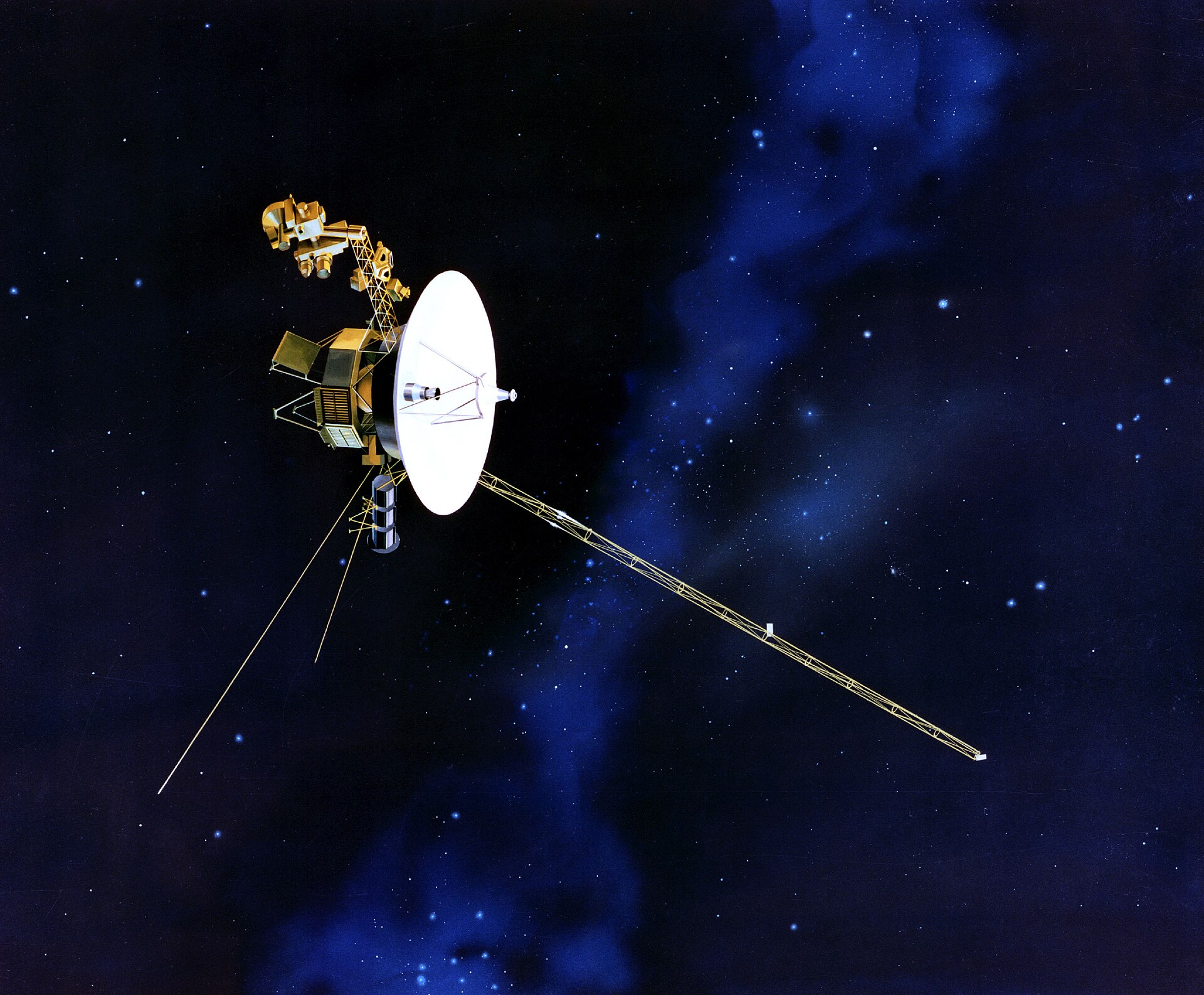
Voyager 1 Hits One Light-Day Distance From Earth
Photo: NASA/JPL, Public domain, via Wikimedia Commons

NASA's Voyager 1 spacecraft reached a distance of one light-day from Earth at 5:16 a.m. EST on Wednesday.
The milestone equals about 16 billion miles or 26 billion kilometers. Voyager 1 remains the farthest spacecraft from Earth and is now moving through the constellation Ophiuchus.
It travels at roughly 38,000 miles per hour in interstellar space. Only two of its 10 scientific instruments continue to operate, and the probe now generates a little more than 210 watts of power.
Suzanne Dodd, the Voyager 1 project manager, called the spacecraft "a national treasure." Planetary Society's Bill Nye said, "All of us – everyone on Earth – have been touched by these missions."
NASA asked the public to blink out the Morse code for VGR in the night sky on Tuesday, according to the Los Angeles Times, to mark the occasion. Jeffrey Hayes said, "This [milestone] essentially kicks off the year's worth of celebrations leading up to the 50th anniversary in August and September of next year."
Voyager 1 left Kennedy Space Center in Florida on September 5, 1977, weeks behind its twin Voyager 2. It completed its Saturn flyby in 1980, finished its primary planetary mission and reached interstellar space in 2012.
The probe took the Pale Blue Dot image of Earth in 1990 and carries a Golden Record with sounds and sights from the planet. NASA expects Voyager 1 to need 18,000 years to cover a full light-year and to pass near the star Gliese 445 in 40,000 years.
Voyager 2 is not expected to reach one light-day until 2035.
Verified Facts
- The one light-day milestone equals roughly 16 billion miles or 26 billion kilometers. (Al Jazeera, Space.com, DW News, Los Angeles Times, CBS News, CNN, The Guardian)
- Voyager 1 was launched on September 5, 1977 from Kennedy Space Center in Florida. (Al Jazeera, Space.com, CBS News, CNN, The Guardian)
- Voyager 1 completed its Saturn flyby in 1980, ending its primary planetary mission. (Al Jazeera, Los Angeles Times, CBS News)
- Voyager 1 is currently traveling at roughly 38,000 miles per hour in interstellar space. (Al Jazeera, Space.com, DW News, CBS News, CNN, The Guardian)
- NASA expects Voyager 1 to take 18,000 years to travel a full light-year. (Al Jazeera, DW News, The Guardian)
- Voyager 2 is expected to reach one light-day from Earth in 2035. (Al Jazeera, Space.com, DW News)
- Voyager 1 project manager Suzanne Dodd described Voyager 1 as a national treasure. (Al Jazeera)
- Voyager 1 took the Pale Blue Dot photo of Earth in 1990. (Al Jazeera, DW News, CBS News, The Guardian)
- Planetary Society’s Bill Nye said all of us on Earth have been touched by these missions. (Al Jazeera)
- Voyager 1 is the farthest spacecraft from Earth. (Space.com, CNN)
- Voyager 1 is currently making its way through the constellation Ophiuchus from the perspective of Earth. (Space.com)
- Jeffrey Hayes said the milestone kicks off a year's worth of celebrations leading up to the 50th anniversary in August and September of next year. (Space.com)
- Voyager 1 was launched a few weeks after its twin Voyager 2. (Space.com, CBS News)
- In October the team briefly lost communication with Voyager 1 and have not yet figured out why. (Al Jazeera, CNN)
- Voyager 1 reached interstellar space in 2012. (DW News, CBS News, CNN)
- Voyager 1 carries a Golden Record with sounds and sights of Earth. (DW News, CBS News, CNN, The Guardian)
- NASA is asking people to flash the Morse code for VGR into the night sky Tuesday to celebrate the milestone. (Los Angeles Times)
- Voyager 1 is now producing a little more than 210 watts of power. (CBS News, CNN)
- Only two of Voyager 1's 10 scientific instruments are still running. (CBS News, CNN)
- The Big Bang fix will allow remaining science instruments to work for longer and bought about two and a half years of power. (CNN)
Sources
- Al Jazeera: NASA’s Voyager 1 to hit new space distance record of one light-day
- Space.com: NASA's interstellar Voyager 1 probe is about to reach 1 light-day from Earth after nearly 50 years in space
- DW News: The first human-made object to travel one light-day from Earth: Make sense of NASA's Voyager 1
- Los Angeles Times: NASA’s Voyager 1 will soon be so far away that its messages take a day to reach Earth
- CBS News: Voyager 1 probe now a full "light day" from Earth, the most distant human artifact in space
- CNN: Voyager 1 is now one light-day from Earth | CNN
- The Guardian: After 49 years, Nasa’s Voyager 1 is one light-day away from us. Can we save this ‘pale blue dot’? |